
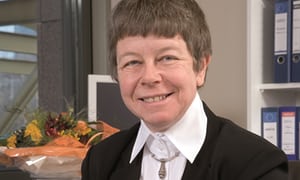
Photo credit: Court of Justice of the European Union
Eleanor Sharpston QC, Advocate General at the European Court of Justice
Interview by Alison Maitland
Eleanor Sharpston QC, the first woman appointed by the UK as Advocate General to the European Court of Justice, is one of the most distinguished contemporary lawyers. Yet her struggle to become a barrister was so difficult that she would have given up if she were, in her own words, “less impossibly stubborn”.
Eleanor, known as “Leo” to her friends, obtained a first-class degree in economics at King’s College, Cambridge, before deciding she wanted to be a barrister in European law.
She faced great obstacles, both financial and social, in establishing herself. “When I went to the Bar, women were tolerated but not encouraged,” she recalls. “It was assumed that they would (only) do family law – ‘so nice for the client to have a sympathetic female shoulder on which to cry’ – or the minor end of criminal law. The idea that a girl would want to do something that required pure intellectual reasoning power, like European Community law, was Martian. When I explained at pupillage interviews that this was what I hoped to do, the usual response was a bemused smile and a quick change of topic.”
She was able to get to the Bar only because she won two major scholarships from Middle Temple, her Inn of Court. One of these, the Sir Peter Bristow scholarship, was the only EC law scholarship at the Bar at that time. She also worked as a freelance motorcycle courier during her pupillage “to deal with the occasional cash flow crisis”.
Astonishingly, it took 10 years from her call to the Bar in 1980 to obtain a full tenancy in London chambers doing EU law. During that time, she worked in a solicitor’s office in Brussels, then in Jeremy Lever QC’s Brussels chambers, then as a “door tenant” (a barrister given permission to work with a set of chambers but from premises outside) in London. “All of this was totally precarious,” she points out.
Just as things were coming unstuck financially, she heard through the grapevine that some posts for law clerks were being created at the European Court of Justice. “I had about 48 hours before the news became public. After a quick trip back to the UK for a conference with my solicitor in my one remaining case, I leapt onto my 250cc motorbike and drove from London to Luxembourg so that I could ‘accidentally’ drop in to see Sir Gordon Slynn, the then British Advocate General at the ECJ, and ask him for the job. Cheek paid off, and professional and financial meltdown were avoided.”
She worked for him for three years, and finally got her London tenancy after briefing some visiting barristers on EU law and the ECJ’s procedure. Unbeknown to her, they were scouting for an EU lawyer, and the briefing session was effectively a tenancy interview.
As a woman, Eleanor says she has managed throughout to avoid being stereotyped. “I am probably the only woman QC who never did a family law case during her practising career,” she says. “My success at avoiding being stereotyped and managing to have the career I wanted in the field of law that fascinated me did, however, come at a price.”
She was, for example, never a high earner at the Bar. “When I ‘took silk’ in 1999, my annual turnover from my practice was still, albeit only just, in five figures – it hadn’t reached six figures. I am certain, though I could never prove this, that I would have had higher fees overall if I had been male. And quite often up to a third of my practice was pro bono European Court of Human Rights work.”
Knowing that she could not live “on thin air” as a barrister, she had simultaneously taken on two full-time jobs at University College London, as lecturer in EC law and Director of European Legal Studies. Although there was only one salary for the two jobs, due to a lack of funding, this was how she finally became established at the Bar. “It’s also, essentially, why I ran an academic career in parallel with my practice at the Bar from then until joining the ECJ as an Advocate General in 2006.”
Eleanor has also not had to juggle family and career. “I got married late (in 1991) to a wonderfully supportive husband – David Lyon – but sadly he died suddenly in 2000 when we were still trying to start a family, and that was that.”
A talented linguist, musician and sportswoman, Eleanor has plenty of entertaining anecdotes about her life as a woman in a male world at the Bar. One relates to her pupillage training in 1980. “I did a mock plea in mitigation and was ‘rewarded’ by having the trainer, who had been downright vicious to two other women in the group, growl at me, ‘I suppose if we have got to have you bloody women at the Bar it’s at least easier to listen to one who sounds like a bloke.’”
She has a naturally low voice and says, “consciously or unconsciously, I’ve always pitched it there because it gives me more authority and gravitas”.
On another occasion, she was working on a proposed merger between a US company and a German company making gearboxes and was about to be shown round the US factory as part of the background briefing. She excused herself and went to the lavatory to change into a pair of trousers.
“My reappearance so clad caused amazement and some disapproval – these were the days when women barristers wore suits composed of jacket and demure skirt,” she recalls. “I explained straight-faced that I wished to be able to go round, look at stuff, bend across to examine how a machine worked and even climb up and down ladders just concentrating on the business at hand. There was a deathly hush. Then one nice man amongst the serried ranks turned to his colleagues and simply said, ‘Gal’s right, you know’. We took it from there and the lengthy factory tour passed without incident.”
